
Understanding conductive heat is important when protecting sensitive components from excessive heat. Heat shields, sleeves, barriers, and insulation can all help, but even a high-temperature thermal protection product can run into problems if it is installed directly against an extreme heat source.
One of the most overlooked reasons for heat-related failure is conductive heat transfer.
Understanding how conductive heat differs from radiant heat can help you get better performance from your thermal protection and avoid damaged wires, hoses, starters, and other components.
What Is Conductive Heat?
Conductive heat is heat transferred through direct physical contact.
If you touch a metal wrench to a hot exhaust manifold, heat begins traveling from the manifold into the wrench. The same thing can happen when a heat sleeve, shield, wire, hose, or thermal barrier rests directly against a hot exhaust component.
The greater the contact and the hotter the heat source, the more severe the heat transfer can become.
How Conductive Heat Affects Thermal Protection
Thermal protection products are designed to reduce the amount of heat reaching the component being protected. Depending on the product and construction, they may help control radiant heat, conductive heat, convective heat, or a combination of all three.
However, a thermal protection product should not automatically be treated as a direct-contact barrier.
For example, a spark plug wire may be protected with a high-temperature sleeve and still experience damage if the sleeved wire is allowed to rest directly against a header tube.
The header transfers heat into the outside of the sleeve through direct contact. That heat can then continue moving through the sleeve material and eventually reach the spark plug wire underneath.
The sleeve is still providing protection, but the installation is exposing it to a different type of heat transfer.
Conductive Heat and Radiant Heat Are Different
Radiant heat travels from a hot object to a nearby component without requiring direct physical contact.
A hot exhaust header can radiate heat toward wiring, fuel lines, hoses, starters, firewalls, and nearby body panels even when those components are not touching the exhaust.
Conductive heat is different because it requires direct contact.
That distinction is important because many thermal protection products perform best when there is some separation between the product and the heat source.
Why Air Gaps Matter
Air is a poor conductor of heat compared with metal and many solid materials. That is why creating separation between the heat source and the component being protected can make such a significant difference.
When a protected wire, hose, starter, or other component is separated from the exhaust, the thermal protection can primarily deal with radiant and ambient heat.
Once the shield or sleeve touches the heat source, the heat path changes. Instead of heat traveling across an air space, direct contact creates a conductive path into the thermal protection.
The starter shield shown here demonstrates this principle. The shield is positioned with an air gap between it and the surrounding heat source. That separation helps the shield reduce radiant exhaust heat instead of becoming a direct conductive path.
Whenever possible, avoid direct contact between thermal protection and extreme heat sources.
Spark Plug Wires Are a Common Example
Spark plug wires are often located extremely close to exhaust headers and manifolds, making them particularly vulnerable to heat.
A spark plug boot protector or heat sleeve can significantly reduce heat exposure, but if the sleeved wire rests directly against a header tube, localized temperatures at the contact point can become much higher than the surrounding area.
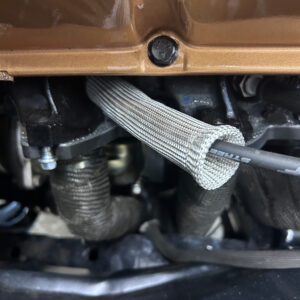
The photo above shows a spark plug wire protected with a heat sleeve and routed near the exhaust. The sleeve helps reduce radiant heat exposure, but maintaining clearance from the exhaust remains important. If the sleeve is allowed to rest directly against a hot header tube, conductive heat can still travel through the sleeve toward the wire underneath.
Over time, that concentrated heat can damage the sleeve, the spark plug boot, or the wire underneath.
The better solution is to combine thermal protection with proper wire routing.
Wire separators, brackets, clips, and other routing methods can help maintain clearance between the protected wire and the exhaust.
Heat Shields Also Benefit From an Air Gap
Air gaps are important with more than just sleeves.
A properly positioned heat shield creates a barrier between the heat source and the component being protected. The air space between the shield, heat source, and protected component helps reduce the amount of heat transferred across the system.
This is why simply placing a shield directly against a hot component is not always the best approach. Proper spacing allows the shield to do its job more effectively.
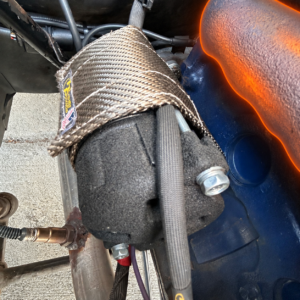
The starter shield shown above demonstrates the principle in action. The air gap helps the shield reduce radiant heat from the nearby exhaust manifold while limiting direct conductive heat transfer from the heat source.
Thermal Protection Works Best as a System
Effective heat management usually involves more than one product or technique.
The best results come from controlling heat at several points:
- Reduce heat at the source when possible.
- Use the correct heat shield, sleeve, barrier, or insulation for the application.
- Maintain clearance between sensitive components and extreme heat sources.
- Use air gaps whenever the installation allows.
- Secure wires and hoses so they cannot move into contact with the exhaust.
- Inspect protected components periodically, especially in high-heat areas.
A properly selected thermal protection product can provide excellent protection, but good installation practices are just as important as the product itself.
Do Not Assume High Temperature Means Direct Contact
Temperature ratings can sometimes be misunderstood.
A material rated for high temperatures may be capable of surviving in a hot environment without being intended for continuous direct contact with a component operating at that same temperature.
Radiant heat exposure, ambient temperature, intermittent heat, and continuous conductive contact are very different conditions.
When selecting and installing thermal protection, always consider how the heat is reaching the component, not just the temperature rating of the product or the heat source.
Control the Heat Path
Heat management is about controlling how heat moves.
If a wire, hose, starter, cable, or other component is exposed to excessive heat, adding thermal protection can be an important part of the solution. But the protected component should still be positioned and secured to minimize direct contact with the heat source.
The combination of proper clearance, an air gap, and the correct thermal protection provides much better protection than relying on a shield or sleeve alone.